
News

Recalibrating Climate Risk: New report urges governments and investors to fix ‘faulty radar’ in climate damage models
5 Feb 2026
Read time: minutes
Recalibrating Climate Risk: New report urges governments and investors to fix ‘faulty radar’ in climate damage models
The Recalibrating Climate Risk report explains why economic models used by governments, central banks and investors are increasingly understating climate risks as the world moves towards 2°C. It shows how this can create a false sense of security – and calls for closer collaboration between climate scientists, economists, regulators and investors.


Led by the University of Exeter’s Green Futures Solutions team, in partnership with Carbon Tracker, the report draws on expert judgement from climate scientists across 12 countries to clarify where today’s ‘damage models’ fall short and what decision-makers should do to manage investment risks under rising uncertainty.
The report builds on earlier work challenging the under-pricing of climate damages in financial decision-making, including Carbon Tracker’s Loading the DICE Against Pensions (2023) and The Emperor’s New Climate Scenarios (IFoA/University of Exeter, 2023). The report examines – in detail – the flaws in current approaches to damage modelling, new measures to improve these models, and implications for regulators, investors and scenario providers.
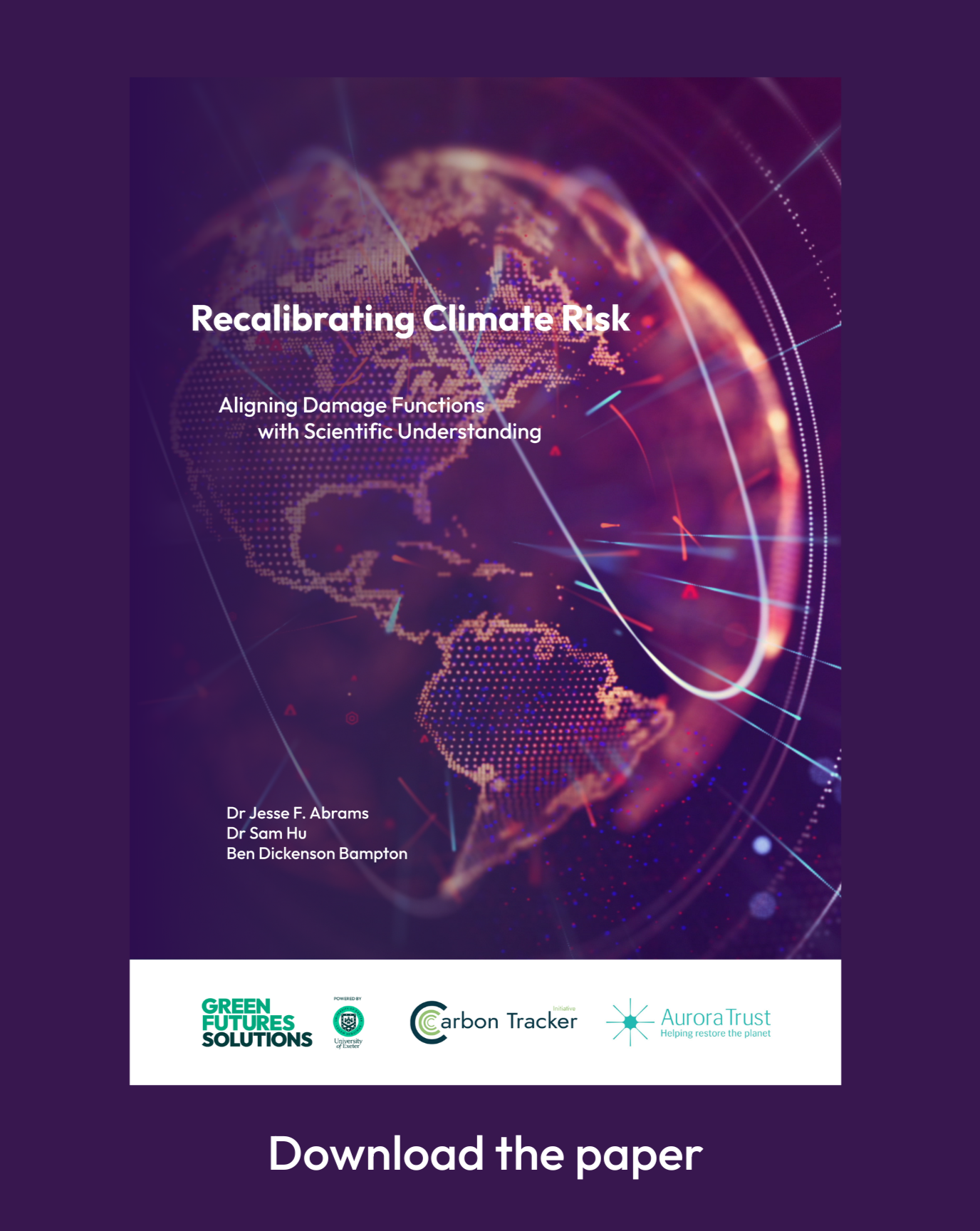
Read the 'Recalibrating Climate Risk' Report

Download the paper arrow

Key Findings

Physical climate damages are structural and compounding

At higher levels of warming, impacts are more likely
to cascade across sectors and geographies, undermining the conditions economies rely on for stable growth. This undercuts against a core assumption in many economic models, which assume that economic growth continues indefinitely, merely at reduced rates.

Extremes matter most, not averages - global mean temperature

While economic modelling has traditionally linked damages to changes in global mean temperature, societies and markets experience climate change through local and regional extremes, such as heatwaves, floods and droughts, which drive the bulk of economic and financial disruption while often barely registering in global averages.

Extremes matter most, not averages - gross domestic product (GDP)

While a useful proxy, gross domestic product (GDP) can mask full harms by failing to account for impacts on mortality and morbidity, inequality, ecosystem loss and social disruption - all factors that undermine societal, human and economic health. As these risks rise, relying on GDP-based assessments can give policymakers and financial institutions a false sense of resilience even as underlying vulnerability increases (e.g. recovery spending that spikes GDP after a climate-related disaster, masking welfare losses entirely).

Uncertainty rises sharply with warming

With temperatures trending towards a 2°C future, experts stress that impacts become increasingly unpredictable, as tipping points and tail risks increase. Even as models continue to produce precise-looking point estimates, climate risks will likely undermine the assumptions of continuous growth fundamental to many economic models. Policymakers should be wary of climate scenarios extending beyond certain temperature levels and take a ‘broad spectrum’ approach to tail risks.
  • "Our expert elicitation reveals a fundamental disconnect: climate scientists understand that beyond 2°C, we're not dealing with manageable economic adjustments."
    - Dr Jesse Abrams
    Lead author and Senior Impact Fellow, University of Exeter
  • "Current economic models systematically underestimate climate damages because they can't capture what matters most - the cascading failures, threshold effects, and compounding shocks that define climate risk in a warmer world and could undermine the very foundations of economic growth."
    - Dr Jesse Abrams
    Lead author and Senior Impact Fellow, University of Exeter
  • "Until the gap between scientists and economists’ expectations of future climate damages is closed and Government bodies act to ensure the integrity of advice upon which investment decisions are made, financial institutions will continue to chronically under-price climate risks"
    - Mark Campanale
    Founder and CEO, Carbon Tracker
  • "As the UK government's landmark security assessment of ecosystem collapse showed last week, we are currently living through a paradigm shift in the speed, scale, and severity of risks driven by the climate-nature crisis. Yet, beyond this report, there has not been a corresponding paradigm shift in how regulators and government as a whole assess these risks."
    - Laurie Laybourn
    Executive Director, Strategic Climate Risks Initiative
  • "The toolkit is broken! Climate change presents an immediate, systemic and material risk to the ecological, societal, and financial stability of every economy and country on the planet - with direct implications for pension providers and their beneficiaries. And yet, when translated through risk tools that are provided to us as investors, damages are estimated in fractions of a percent. The consequence is a failure to equip pension funds with a fully informed range of climate outcomes that can help them to address a fundamental systemic risk to the fund’s financial performance."
    - Faith Ward
    Chief Responsible Investment Officer, Brunel Pension Partnership
  • “Phoenix supports the report’s call for a more robust and co-ordinated approach to climate‑risk modelling. Underestimating physical risk doesn’t just distort financial analysis and investment decisions, it underplays the real‑world consequences that will ultimately affect customer outcomes and society as a whole. As one of the UK’s largest asset owners, we urge policymakers to act decisively on the systemic risks identified in this research and to set clear expectations for financial sector users”
    - Hetal Patel
    Head of Sustainable Investment Research, Phoenix Group
Learn More

Recalibrating Climate Risk was authored by Dr Jesse Abrams (lead), Dr Sam Hu and Ben Dickenson Bampton in the University of Exeter’s Green Futures Solutions team. It was developed in partnership with Carbon Tracker and with funding from the Aurora Trust. It brings together expert judgement from 68 climate scientists across 12 countries, to develop an early consensus and research agenda to improve damage modelling.


To learn more about this research and its implications for policymakers, investors and scenario providers, please contact us.


For media enquiries, please contact Ben Dickenson Bampton.